Imagine contacting a business on WhatsApp to book an appointment. Instead of receiving a link to another website, you’re offered available times, choose one that suits you and receive your booking confirmation — all within the same conversation.
That’s what effective WhatsApp automation should look like.
Yet many businesses still rely on rigid chatbots that send predefined responses, redirect customers to external websites and struggle to understand the context of a conversation.
The result is often an automated version of the same inconvenient customer experience.
The real opportunity is not simply automating messages. It’s automating entire business processes while keeping customer interactions natural, convenient and personal.
For businesses in the UAE, WhatsApp can become more than a communication channel. With the right integrations, it can serve as a connected interface for customer support, sales, appointment management and everyday operations.
What is WhatsApp automation?
WhatsApp automation is the use of software to manage customer conversations and perform business tasks through WhatsApp without requiring a team member to manually handle every interaction.
At its simplest, this might involve automatically sending a welcome message, answering frequently asked questions or notifying customers about an appointment.
More advanced implementations can connect WhatsApp to booking systems, customer relationship management platforms, product inventories and other business applications.
An AI-powered assistant can then understand what a customer needs, retrieve relevant information and perform authorised actions based on the conversation.
The difference is important: automatically sending a message is not the same as automatically resolving a customer’s request.
How does WhatsApp automation work?
Business-grade WhatsApp automation typically uses the official WhatsApp Business Platform, which allows businesses to connect WhatsApp conversations to their own software and operational systems.
When a customer sends a message, an automation system can interpret their request, retrieve information from connected applications and execute an authorised business action.
For example, an appointment booking assistant can retrieve live availability from a scheduling system, confirm the customer’s preferred time and create a booking. The customer receives confirmation directly within WhatsApp.
AI handles the conversation, while controlled software integrations execute and validate business actions.
Why WhatsApp automation matters for UAE businesses
Businesses across industries use WhatsApp to communicate with customers, answer enquiries and arrange services.
However, managing these conversations manually creates challenges as a business grows.
Customers may contact a company outside working hours. Employees may spend significant time answering repetitive questions. Sales enquiries can become buried in conversations, and appointment bookings may require several messages before they are confirmed.
WhatsApp automation can address these problems without requiring customers to adopt a completely new communication channel.
For UAE businesses serving both Arabic-speaking and English-speaking customers, multilingual automation can also help provide more consistent service across languages.
The objective should not necessarily be to replace employees. It should be to reduce repetitive work and allow employees to concentrate on situations that genuinely require human judgement.
What can businesses automate through WhatsApp?
The most valuable automation opportunities depend on how a business operates and what its customers regularly need.
Appointment bookings
Clinics, salons, veterinary practices, automotive service centres and other appointment-based businesses can connect WhatsApp to their scheduling systems.
Instead of sending a customer a booking link, an automated assistant can check available appointments, present suitable options and confirm a reservation.
It can also help customers reschedule appointments and receive reminders, subject to the applicable messaging rules.
The entire interaction can take place within WhatsApp.
Lead qualification and sales enquiries
When a potential customer contacts a business, an intelligent assistant can ask relevant questions to understand their requirements.
For example, a car dealership could ask about the customer’s preferred vehicle, budget and availability for a viewing.
The assistant could retrieve suitable vehicles from an inventory system, provide relevant details and arrange a showroom appointment.
A real estate agency in Dubai could use WhatsApp automation to understand a prospective buyer’s budget, preferred location and property requirements, retrieve matching listings and arrange a viewing directly within the conversation.
Qualified enquiries can then be transferred to the sales team with the conversation history and relevant customer information.
By connecting WhatsApp to a CRM, businesses can reduce the amount of information that needs to be entered manually.
For companies with more complex requirements, custom CRM development can help create a connected sales workflow around their existing operations.
Customer support
Many customer support enquiries involve recurring questions about pricing, availability, delivery, returns or business policies.
An AI-powered WhatsApp assistant can answer these questions using approved business information.
When connected to the appropriate systems, it can also retrieve order details, check service requests or provide account-specific information after the required identity checks.
More complicated or sensitive requests should be transferred to a human employee.
This is where AI customer support becomes more useful than a conventional automated FAQ.
Order updates and notifications
E-commerce businesses and service providers can use WhatsApp to communicate relevant updates, including:
- Order confirmations.
- Delivery notifications.
- Appointment reminders.
- Service progress updates.
- Payment reminders.
These notifications should follow WhatsApp’s messaging requirements, including applicable consent, template and customer communication rules.
Customers should also have a straightforward way to stop receiving optional messages.
Internal business workflows
WhatsApp automation does not have to be limited to customer-facing conversations.
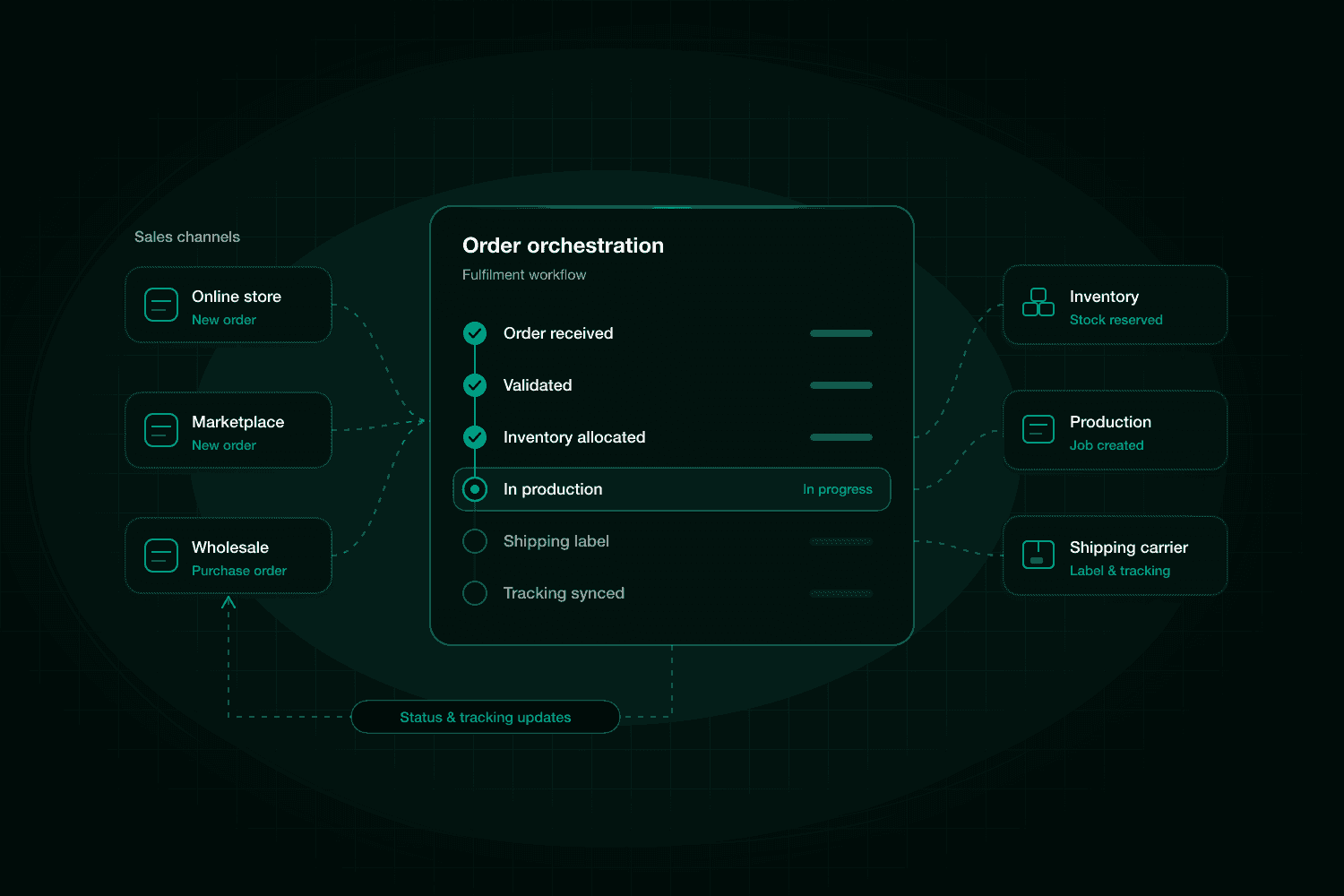
A customer enquiry can trigger an internal process such as creating a support ticket, notifying a department, assigning a sales representative or updating a business record.
Connecting these actions through business process automation can reduce duplicated work and improve coordination between teams.
Traditional WhatsApp chatbots vs AI-powered automation
Not every WhatsApp chatbot provides the same experience.
Traditional rule-based chatbots typically follow predefined conversation flows. Customers select options, enter specific keywords or follow a fixed sequence of questions.
These systems can be useful for simple and predictable tasks. However, they may become frustrating when a customer asks something unexpected, changes their mind or refers to information mentioned earlier.
AI-powered assistants can be designed to interpret natural language, maintain relevant conversational context and interact with connected business systems.
Consider the following illustrative example.
Traditional chatbot
- Customer: I'd like to book an appointment tomorrow.
- Chatbot: Please visit our website to book an appointment.
Integrated AI assistant
- Customer: I'd like to book an appointment tomorrow.
- Assistant: We have availability tomorrow at 10:30 AM, 2:00 PM and 4:30 PM. Which time works best for you?
- Customer: The afternoon, please.
- Assistant: Would you prefer 2:00 PM or 4:30 PM?
- Customer: 2:00 PM.
- Assistant: Your appointment is confirmed for tomorrow at 2:00 PM.
The second approach is not valuable simply because its responses sound more natural. It is valuable because it completes a task.
| Capability | Rule-based chatbot | Integrated AI assistant |
|---|---|---|
| Predefined responses | Yes | Yes |
| Flexible natural-language conversations | Limited | Supported when properly designed |
| Conversational context | Often limited | Can maintain relevant context |
| Live business information | Requires integration | Requires integration |
| Completing business actions | Possible with configured workflows | Possible with connected tools and workflows |
| Human handover | Can be configured | Can be configured |
AI is not automatically the better choice for every situation. Simple workflows may be more reliable and economical when implemented using deterministic rules.
Effective systems often combine both approaches, using AI to understand customer requests and controlled business logic to execute actions reliably.
Ready-made platforms or custom WhatsApp automation?
Businesses generally have two approaches to implementing WhatsApp automation: adopting an existing software platform or developing a solution around their specific requirements.
Ready-made platforms
An existing platform can be a sensible choice when a business needs standard features such as automated greetings, shared inboxes, message templates and basic conversation flows.
These platforms can reduce initial implementation effort and provide useful functionality without requiring a custom software project.
However, businesses may encounter limitations when they need specialised integrations, complex workflows or greater control over how conversations are handled.
Custom-built solutions
A custom WhatsApp automation solution is designed around the business’s actual processes rather than requiring the business to fit its operations into a predefined platform.
It can connect existing scheduling software, databases, CRM systems and internal applications.
A custom implementation may be particularly appropriate when:
- Customers need to complete actions directly within WhatsApp.
- Multiple business systems must work together.
- Conversation flows require specialised business logic.
- The business needs more control over integrations and data handling.
- Existing software cannot support the required workflows.
Custom development typically requires greater initial investment, ongoing maintenance and careful technical design.
The right approach depends on business requirements, not simply the number of available features.
Our WhatsApp Business Automation solutions are designed around the processes businesses need to automate, including integrations with their existing systems.
How much does WhatsApp automation cost in the UAE?
There is no single price for implementing WhatsApp automation.
Costs depend on whether a business needs basic messaging automation or a fully integrated system capable of completing transactions and executing business workflows.
A typical implementation may include several cost components:
- Initial configuration or custom development.
- Software subscriptions, where applicable.
- WhatsApp messaging charges.
- AI model usage.
- Hosting and infrastructure.
- Integrations with existing systems.
- Ongoing maintenance and technical support.
A basic automated messaging workflow is generally less complex than an AI assistant connected to multiple business applications.
Businesses should also consider the ongoing cost of operating the solution, rather than evaluating only the initial implementation price.
The most useful way to determine a budget is to identify which processes will be automated, what systems need to be connected and how many customer interactions the solution must support.
How to measure the return on WhatsApp automation
The success of an automation project should not be measured by the number of automated messages sent.
Instead, businesses should measure whether automation improves customer experience and operational performance.
Useful metrics include:
- Average response time.
- Percentage of enquiries resolved without human intervention.
- Appointment booking completion rate.
- Lead-to-customer conversion rate.
- Employee time spent on repetitive enquiries.
- Customer satisfaction.
- Human escalation rate.
- Incorrect or unsuccessful automated actions.
For example, an appointment-based business could compare the number of completed bookings before and after introducing automated scheduling.
A sales team could measure whether qualified enquiries are handled faster and whether fewer leads are missed outside working hours.
These measurements help determine whether automation is creating measurable business value.
How to implement WhatsApp automation in your business
A successful implementation begins with understanding the business, not selecting an AI model or chatbot platform.
1. Identify repetitive customer interactions
Review the types of enquiries your business receives regularly.
Determine which interactions consume significant employee time and which create unnecessary friction for customers.
2. Define the desired outcome
Decide what the automation should actually achieve.
For example, rather than defining a requirement as answering appointment questions, define it as helping customers find an available appointment and complete their booking.
3. Connect the necessary business systems
Identify which applications contain the information required to complete each task.
This might include scheduling software, CRM systems, inventory databases, e-commerce platforms or customer support applications.
4. Establish rules and safeguards
Define what the assistant is authorised to do, which information it can access and when it should escalate conversations to employees.
Business-critical actions should use validated information and controlled workflows rather than relying solely on generated AI responses.
The implementation should also account for applicable privacy requirements, WhatsApp messaging policies and customer consent.
5. Test real customer scenarios
Test conversations involving incomplete information, changes of mind, unavailable appointments, different languages and unexpected requests.
Evaluate whether the assistant can recover gracefully and transfer customers to employees when necessary.
6. Launch and improve
Start with clearly defined workflows, monitor their performance and expand automation based on measurable results.
The goal is to build a reliable system that supports business growth, not to automate every interaction immediately.
ReemRose’s AI and business automation services combine software engineering, business integrations and AI to address these operational requirements.
Frequently asked questions
What is WhatsApp automation for business?
WhatsApp automation allows businesses to automatically manage customer messages and perform tasks such as answering enquiries, scheduling appointments, qualifying leads and sending notifications through WhatsApp.
Can an AI WhatsApp chatbot book appointments automatically?
Yes. When connected to a compatible scheduling system, an AI assistant can check availability, offer appointment times and confirm bookings within WhatsApp.
Can WhatsApp automation support Arabic and English?
Yes. A properly designed multilingual solution can support both Arabic and English. Businesses should test language accuracy, dialect handling and conversational quality before deployment.
Can WhatsApp automation integrate with my existing CRM?
Yes, provided the CRM offers suitable integration capabilities. A connected system can create customer records, update existing information and transfer qualified leads to sales teams.
Do I need custom software for WhatsApp automation?
Not always. Ready-made platforms may be sufficient for basic messaging and standard workflows. Custom development becomes more relevant when a business requires specialised integrations, advanced conversational behaviour or complex operational processes.
Can WhatsApp automation replace my customer service team?
Automation can reduce repetitive workloads, but human involvement remains important for complex, sensitive or unusual situations. The best implementations include reliable human handover.
Build WhatsApp automation around your business
WhatsApp automation should make interactions easier for customers and operations more efficient for employees.
Whether your business needs automated appointment bookings, intelligent customer support, connected sales workflows or integrations with existing software, the starting point is understanding what your customers need to accomplish.
At ReemRose, we develop WhatsApp automation solutions around real business processes, combining AI with custom software engineering and system integrations.
Explore our WhatsApp Business Automation solutions or contact our team to discuss your requirements.
Back to Insights