Two participants are watching the same online auction.
The current price is $500, the minimum bid increment is $50, and only a few seconds remain before closing.
Both participants submit a bid of $550 almost simultaneously.
Their browsers send requests to the platform. Both expect to become the leading bidder.
But the auction cannot simply accept both requests against the same previous state.
It must determine which bidding instruction is accepted first, evaluate subsequent requests against the updated state and communicate a consistent result to everyone watching the auction.
This is the fundamental engineering challenge behind real-time auction software.
Real-time bidding is not simply about sending updates quickly. It is about processing competing financial instructions correctly while maintaining a synchronised participant experience.
This article concerns real-time bidding on assets and products in online auctions, rather than advertising auctions.
What is a real-time auction bidding system?
A real-time auction bidding system allows participants to submit offers and receive timely updates about the auction’s confirmed state.
These updates may include:
- Current accepted price.
- Leading bidder status.
- Minimum next bid.
- Remaining auction time.
- Auction extensions.
- Auction completion.
- Personal outbid notifications.
A reliable system separates the communication of auction updates from the processing of bidding instructions.
The bidding engine determines what has happened.
The real-time communication layer distributes that confirmed information to participants.
This distinction is central to designing a reliable auction platform.
The architecture behind real-time bidding
A representative auction architecture contains several connected responsibilities.
Participant applications
Web and mobile applications display auction information and allow participants to submit bidding instructions.
They should distinguish between a request that has been submitted, a request still being processed and a confirmed auction result.
Displaying an unconfirmed bid as accepted may mislead the participant.
Authentication and backend API
The backend verifies the participant’s identity, permissions and eligibility.
It validates requests and forwards authorised bidding instructions to the appropriate processing logic.
Bids may be submitted through an HTTP API or another authenticated communication mechanism.
The transport does not determine whether the bid is valid.
Bidding engine
The bidding engine evaluates the auction rules.
It determines whether the auction is open, whether the participant is eligible, whether the amount satisfies the current requirements and how automatic bidding or closing rules affect the resulting state.
Authoritative transactional state
The authoritative state records accepted bidding outcomes, current prices, leading participants, confidential bidding instructions and closing conditions.
A relational database such as PostgreSQL can support this role in many auction architectures.
The important requirement is that competing state changes are coordinated through an appropriate consistency strategy.
Real-time event delivery
After an auction state change has been committed, the platform can distribute the confirmed update to participants through technologies such as WebSockets or Server-Sent Events.
The communication layer should not independently decide which bid wins.
-
Committed auction state
The accepted result is stored
-
Event publisher
Reads the committed change
-
Real-time communication
WebSockets or Server-Sent Events
-
Connected participants
Receive the confirmed update
Background processing
Background processes may handle notifications, payment reminders, reporting and other operational workflows.
These responsibilities should be separated from the critical bidding operation when possible.
However, auction closure must remain coordinated with the authoritative bidding state.
What happens when someone submits a bid?
Consider a participant submitting an offer of $550 against a confirmed auction price of $500.
A representative processing sequence is:
- The participant submits an authenticated bidding instruction.
- The backend verifies the request and participant eligibility.
- The bidding engine obtains or conditionally updates the authoritative auction state.
- The auction rules are evaluated against that state.
- The resulting price, leading bidder and closing timestamp are calculated.
- The accepted state change is committed.
- A confirmed result is returned and the update is made available for distribution.
- Connected participants receive the updated auction information.
-
Participant
Sends an authenticated bidding instruction
-
API
Verifies the request and eligibility
-
Bidding engine
Evaluates the rules against the authoritative state
-
Transaction commit
The accepted state change is stored
-
Confirmed result
Returned to the participant
Not every request will result in an accepted bid.
The request may be rejected because the auction has closed, the participant is not eligible, the offered amount is no longer sufficient or another rule has not been satisfied.
The application must communicate these outcomes clearly.
How simultaneous bids are processed
Suppose the current accepted price is $500 and the minimum increment is $50.
Two participants submit manual bids of $550.
For this illustrative example, assume bids are processed in a defined serial order, with no proxy bidding or reserve-price interaction.
| Event | Authoritative result |
|---|---|
| Initial state | Current price is $500 |
| Bidder A’s $550 request is processed first | Accepted; current price becomes $550 |
| Bidder B’s $550 request is processed next | Rejected; minimum next bid is now $600 |
| Bidder B submits a new offer of $600 | Accepted if all other rules are satisfied |
The exact ordering policy depends on the auction’s published rules and processing architecture.
A reliable system must not rely on the timestamp supplied by a participant’s browser as unquestionable evidence of bidding priority.
Potential consistency strategies include:
- Database row-level locking.
- Optimistic concurrency control.
- Serialised processing for individual auctions.
Each approach has trade-offs involving contention, latency, throughput and implementation complexity.
The correct strategy depends on the expected workload and auction requirements.
Preventing duplicate bids
Network requests do not always produce an immediate response.
A participant may submit a bid, experience a connection timeout and retry the request without knowing whether the first instruction was accepted.
If the original instruction was successfully processed, the retry should not unintentionally create another bidding operation.
One common approach is to associate a unique idempotency key with a bidding instruction.
The server can recognise a repeated instruction and return its previously established result, provided the key is used with the same authenticated participant, operation and payload.
A genuinely new bidding instruction should use a new identifier.
Idempotency does not mean a network request is guaranteed to arrive exactly once.
It means the application is designed to handle appropriate retries without repeatedly applying the same intended operation.
This is especially important when a bid can trigger automatic bidding, closing-time extensions or financial obligations.
Implementing proxy bidding correctly
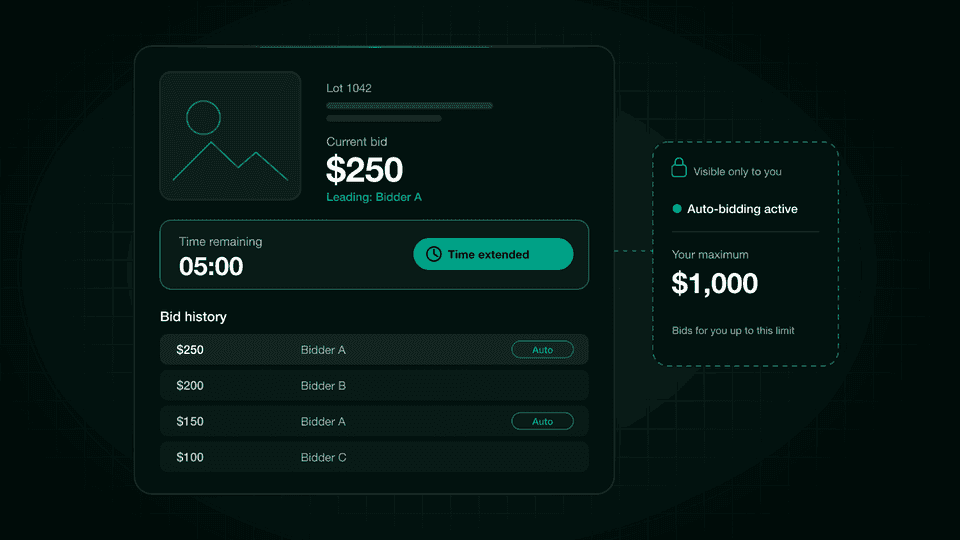
Proxy bidding allows a participant to specify a maximum amount that the platform is authorised to bid on their behalf.
The maximum is not explicitly disclosed to competing participants.
Instead, the bidding engine calculates the public auction price according to the rules governing increments, competing maximums and bidder priority.
ReemRose’s engineering experience includes implementing this mechanism in custom auction software.
Consider an illustrative auction with a $50 increment and no reserve-price interaction.
Bidder A has authorised a maximum of $1,000. The public price is $150.
| Competing instruction from Bidder B | Resulting public price | Leading bidder |
|---|---|---|
| Maximum of $200 | $250 | Bidder A |
| Maximum of $400 | $450 | Bidder A |
| Maximum of $950 | $1,000 | Bidder A |
| Maximum of $1,000 | $1,000 | Bidder A, assuming earlier maximum wins ties |
| Maximum of $1,050 | $1,050 | Bidder B |
This example assumes a specific earlier-maximum priority rule and allows an equal-maximum instruction to participate in tie resolution even though the displayed price is already $1,000.
A platform enforcing a strict minimum next bid for every new maximum instruction might reject that equal-maximum request instead.
Both behaviours must be deliberately defined rather than left to accidental implementation details.
The public auction price can reveal or allow participants to infer information about maximums through subsequent bidding activity. However, the private maximum should not be explicitly exposed through public responses or events.
Internally, the engine may evaluate several competing values, but the resulting auction state should be committed consistently.
An implementation should avoid generating uncontrolled sequences of competing automatic requests when a deterministic calculation can resolve the outcome.
Implementing popcorn bidding without timing inconsistencies
Popcorn bidding, also known as soft-close or anti-sniping bidding, gives participants additional time to respond when an eligible bid is accepted shortly before an auction closes.
Consider an auction scheduled to close at 20:00:00.
The platform applies a five-minute soft-close rule.
| Event | Server closing timestamp |
|---|---|
| Original scheduled closing time | 20:00:00 |
| Eligible bid accepted at 19:58:00 | 20:03:00 |
| Another eligible bid accepted at 20:01:00 | 20:06:00 |
| No further eligible bids | Auction closes according to its rules at 20:06:00 |
-
Scheduled close
The server's closing timestamp is 20:00:00
-
Bid accepted at 19:58:00
Closing timestamp moves to 20:03:00
-
Bid accepted at 20:01:00
Closing timestamp moves to 20:06:00
-
No further eligible bids
The auction closes at 20:06:00
The new closing timestamp is calculated from the relevant authoritative acceptance time and configured extension rule.
Participants receive the updated closing timestamp.
Their browsers then display a countdown based on that information.
The server must remain responsible for determining whether the auction is open or closed.
An extension should not depend on a participant keeping their browser connected.
Handling the race between bidding and auction closure
One of the most difficult scenarios occurs when a bidding instruction and an auction closure operation compete near the deadline.
Imagine that an auction is scheduled to close at 20:00:00.
A participant submits a request near that time while a background process attempts to close the auction.
Without proper coordination, one process might accept a bid and extend the closing time while another simultaneously marks the auction as closed.
A reliable implementation must coordinate both operations against the same authoritative state.
The system also needs an explicit deadline policy.
For example, eligibility may depend on when the server receives a request or when the authoritative bidding operation evaluates it.
Those policies produce different outcomes when requests are delayed or queued.
The selected policy should be technically enforceable, consistently applied and clearly reflected in the auction terms.
The platform should not accept late bids simply because a closure job has not run yet.
Nor should a previously scheduled closure job ignore a valid extension to the auction’s closing timestamp.
Why WebSockets alone do not make an auction reliable
WebSockets provide a persistent, bidirectional communication channel between a client and server.
They are useful for distributing auction updates without requiring participants to repeatedly refresh the page.
However, WebSockets do not automatically provide:
- Transactional consistency.
- Bid priority.
- Duplicate-request protection.
- Durable auction state.
- Confidential maximum handling.
- Correct auction closing rules.
- Recovery of missed application events.
A WebSocket server can distribute incorrect information just as quickly as correct information.
The communication layer should therefore distribute confirmed outcomes produced by the authoritative bidding engine.
For some platforms, Server-Sent Events combined with a conventional bidding API may also be an appropriate choice.
The choice should follow communication requirements rather than architectural fashion.
Keeping every participant synchronised
An auction platform must account for participants connecting at different times and experiencing different network conditions.
An application may temporarily lose its connection, miss an update or receive an event after more recent information has already been displayed.
A useful design is to associate a monotonically increasing version with each auction state.
For example:
| Auction state version | Confirmed price |
|---|---|
| 41 | $500 |
| 42 | $550 |
| 43 | $600 |
If a participant has already received version 43, a delayed version 42 should not overwrite it.
If an application detects a missing version or reconnects after an interruption, it can retrieve a fresh authoritative snapshot.
Depending on the architecture, the system may also support replaying missed events.
The application should not assume that a persistent connection guarantees uninterrupted access to the latest auction state.
Publishing events after database transactions
Consider a bidding engine that updates the database and then broadcasts an auction event.
If the broadcast occurs before the transaction commits, participants might receive an update describing a bid that ultimately fails.
If the transaction commits but the event publication fails, the bid may be accepted without connected participants receiving its update.
One approach to coordinating these operations is the transactional outbox pattern.
The accepted auction state and a pending event record are written within the same database transaction.
A separate publisher subsequently distributes the committed event.
-
Auction state
Inside the transaction: the accepted change is written
-
Pending event
Inside the same transaction: the event record is written
-
Commit
Both writes are stored together, or neither is
-
Event publisher
After the commit: reads and sends pending events
-
Connected clients
Receive the confirmed update
This makes event publication recoverable without requiring the original request to complete every downstream communication operation.
The approach still requires appropriate handling of retries, duplicate events, ordering and operational monitoring.
It does not create a universal exactly-once delivery guarantee.
For a smaller platform, simpler designs may also be appropriate, provided their failure conditions are understood and managed.
Scaling the bidding engine
An auction platform has different types of traffic.
Many participants may browse listings or subscribe to real-time updates, while a smaller number actively submit bids.
These workloads should be considered separately.
Read-heavy traffic may benefit from caching, efficient database queries and content delivery networks.
Real-time connections may require horizontally scalable communication infrastructure.
Accepted bid processing requires reliable coordination of competing state changes.
Different auctions can often be processed independently, while bids affecting the same auction need a consistent coordination strategy.
Partitioning work by auction identifier is one possible design when the workload justifies it.
However, the system must preserve the required ordering and consistency guarantees during retries, worker failures and recovery.
More servers do not automatically make a heavily contested individual auction easier to process.
The consistency requirements of that auction remain.
Protecting confidential bidding information
Auction systems may contain commercially sensitive information.
This includes maximum authorised amounts, bidder identities, verification records and financial transaction references.
Public auction updates should contain only the information participants are authorised to receive.
Private participant events may provide additional information to the appropriate authenticated account.
For example, a participant may need to see whether their automatic bidding instruction is active without exposing its maximum to other users.
Authorisation should be enforced by the server when subscriptions, requests and private events are processed.
Confidential bidding information should not appear in public event payloads, general-purpose logs or unauthorised analytics tools.
Testing real-time auction software
An auction platform should be tested against realistic operational conditions.
Useful scenarios include:
- Multiple users submitting the same minimum bid.
- Competing confidential maximum bids.
- Equal maximum amounts.
- Variable bid increments.
- Reserve-price interactions.
- Bids near the closing deadline.
- Repeated soft-close extensions.
- Duplicate requests.
- Database transaction conflicts.
- Delayed or duplicated events.
- Network disconnections.
- Worker failures during auction closure.
- High numbers of simultaneous viewers.
Performance testing should measure more than average response times.
Useful measurements may include bid-processing latency, transaction contention, event-delivery lag, rejected requests, reconnection behaviour and consistency violations.
Correctness tests should establish important invariants.
For example:
- An automatic bid never exceeds its authorised maximum.
- A closed auction cannot accept an ineligible late bid.
- The public auction state cannot regress to an older version.
- Retrying the same accepted instruction does not create a new operation.
- A valid extension is not overwritten by an outdated closure process.
The objective is to maintain correct auction outcomes even when infrastructure or network conditions are imperfect.
Frequently asked questions
What technology is used for real-time auction bidding?
Auction platforms commonly combine backend application services, transactional databases and real-time communication technologies such as WebSockets or Server-Sent Events. The specific architecture depends on the auction rules, expected traffic and reliability requirements.
Are WebSockets required for online auction platforms?
Not necessarily. WebSockets are one useful communication option, but other approaches may be appropriate depending on the required update frequency and interaction model.
How does an auction platform decide which simultaneous bid wins?
The bidding engine applies a defined ordering policy and concurrency strategy to competing requests. Subsequent instructions are evaluated against the appropriate authoritative state.
Can proxy bidding and popcorn bidding operate together?
Yes. Their interaction must be explicitly defined, including how an external bidding instruction affects the public price, bidder priority and auction closing timestamp.
How do auction platforms prevent duplicate bids?
They can use idempotency mechanisms that recognise retries of the same bidding instruction and prevent the intended operation from being applied repeatedly.
What happens when a bidder loses their internet connection?
The authoritative auction continues on the server. When the participant reconnects, their application should retrieve the latest confirmed state and reconcile any outstanding bidding instructions.
Can a real-time auction platform scale to thousands of participants?
A properly designed architecture can support substantial participant activity, but actual capacity depends on workload characteristics, infrastructure, implementation and performance testing. Simultaneous viewers and concurrent bids are different engineering requirements.
Build a reliable real-time auction platform
The success of an online auction platform depends on more than how quickly the interface updates.
It requires a bidding engine that enforces the auction rules, maintains reliable transactional state and communicates consistent results to participants.
ReemRose develops custom software around these engineering requirements, including advanced bidding mechanisms, real-time communication, transactional systems and business integrations.
Explore our auction platform development solutions, read our complete auction development guide, review what influences auction platform development costs, or contact our team to discuss the technical requirements of your project.
Back to Insights