Imagine an online auction with hundreds of participants watching the same item. With only a few seconds remaining, several bidders submit offers almost simultaneously.
Which bid should be accepted first? Should the auction close immediately or give other participants an opportunity to respond? What happens when someone has already authorised the system to bid automatically on their behalf?
These questions illustrate why developing an online auction platform is fundamentally different from building a conventional e-commerce website.
An auction platform must manage changing prices, competing participants, strict timing rules, financial transactions and real-time updates while maintaining a fair and consistent experience for everyone.
This guide explores the features, bidding mechanisms, software architecture and development decisions involved in building a reliable online auction platform.
What is an online auction platform?
An online auction platform is a digital system that allows participants to compete for products, assets or services through a structured bidding process.
Unlike traditional e-commerce, where products generally have a predetermined price, an auction determines the final price according to its bidding rules and participant activity.
An auction platform may serve a single business selling its own inventory or operate as a marketplace where multiple sellers list items and buyers compete for them.
Common applications include:
- Automotive and vehicle auctions.
- Industrial equipment and machinery.
- Collectibles, art and luxury goods.
- Liquidation and surplus inventory.
- Business-to-business procurement.
- Electronics and refurbished products.
- Property auctions, subject to applicable legal requirements.
Each market has different operational requirements. A platform selling industrial machinery may require different identity verification, payment and inspection workflows from a marketplace selling collectibles.
This is why auction software development should begin with the business model rather than a predefined list of website features.
Types of online auctions
Before developing an auction platform, businesses need to determine which auction models they intend to support.
Ascending-price auctions
Participants compete by submitting progressively higher bids.
The auction generally concludes when its closing conditions are met, and the highest eligible bidder wins, provided any applicable reserve price or other sale conditions have been satisfied.
This is a common model for vehicles, collectibles and general merchandise.
Dutch auctions
The price begins at a higher level and decreases according to predefined rules until a participant accepts the current price.
Sealed-bid auctions
Participants submit bids without seeing competing offers.
The winner is determined according to the auction’s predefined evaluation and selection rules.
Reverse auctions
Suppliers compete to provide goods or services, often by offering progressively lower prices.
This model is commonly associated with procurement and supplier selection.
Live and timed auctions
Timed auctions follow a scheduled opening and closing process, while live auctions may involve an auctioneer managing the bidding progression.
Some platforms support both models.
Supporting multiple auction types increases the complexity of the bidding engine, administration tools and testing requirements. Businesses should initially focus on the auction models that fit their actual operations.
Essential features of an online auction platform
The visible bidding interface is only one part of a complete auction system.
A reliable platform requires connected functionality for participants, sellers, administrators and the software responsible for enforcing auction rules.
User registration and bidder verification
Users should be able to register, manage their accounts and participate in auctions according to the platform’s eligibility requirements.
Depending on the business model, this may include email verification, identity checks, business verification or refundable bidding deposits.
Verification requirements should be proportionate to the value of the assets, transaction risks and applicable regulations.
Auction listings and asset management
Auction listings should provide participants with the information necessary to make informed bidding decisions.
This may include:
- Product descriptions and specifications.
- Images and supporting documents.
- Condition reports.
- Opening prices.
- Minimum bid increments.
- Auction opening and closing times.
- Delivery or collection requirements.
- Seller information where applicable.
Administrators or sellers should be able to prepare listings, schedule auctions and manage inventory through structured workflows.
Real-time bidding and auction countdown
Participants need timely information about the current price, auction status and remaining time.
When an eligible bid is accepted, the updated auction state should be distributed to connected participants.
Real-time updates reduce confusion and allow bidders to make informed decisions without manually refreshing the page.
However, displaying updates instantly is not enough.
The server must remain responsible for validating bids, determining their accepted order and enforcing the auction’s closing rules.
The countdown displayed in a browser should reflect the authoritative auction state on the server rather than independently determining when bidding closes.
Configurable bid increments
A bid increment defines the minimum amount by which a new bid must normally exceed the current accepted price.
For example, an auction may require increases of $50.
More advanced platforms can support increment schedules that change as the auction price increases.
These rules must be consistently enforced by the bidding engine and clearly communicated to participants.
Reserve prices and buy-now options
Some auctions require a minimum acceptable sale price, known as a reserve price.
If the reserve is not reached, the highest bid may not result in a completed sale.
Platforms may also support a buy-now option, allowing an eligible participant to purchase an item at a predetermined price under defined conditions.
The system must clearly define how reserve prices, buy-now offers and active bids interact.
Advanced bidding mechanisms
A basic bidding system allows users to manually submit competing offers.
More advanced auction platforms can implement mechanisms that improve the bidding experience and address specific limitations of conventional timed auctions.
Two particularly useful mechanisms are popcorn bidding and proxy bidding.
ReemRose’s engineering experience includes implementing both mechanisms in custom auction software. Their behaviour must be defined precisely because each accepted bid can affect both the auction price and its closing conditions.
Popcorn bidding: preventing last-second bidding
Popcorn bidding, also known as soft-close or anti-sniping bidding, is a mechanism that extends an auction when an eligible bid is accepted close to its scheduled closing time.
Without this mechanism, participants may wait until the last possible second to submit a bid, leaving other participants without sufficient time to respond.
Consider an auction that uses a five-minute soft-close rule.
When a valid bid is accepted during the final five minutes, the remaining time is reset to five minutes.
For example:
| Event | Remaining time |
|---|---|
| Auction approaches its scheduled closing time | 04:30 |
| A valid bid is accepted | 05:00 |
| No new bids are accepted for three minutes | 02:00 |
| Another valid bid is accepted | 05:00 |
| No further eligible bids are accepted | Auction closes when the timer reaches zero |
The auction can therefore continue beyond its original scheduled closing time until the configured closing conditions are met.
This gives competing bidders an opportunity to respond instead of allowing the result to depend entirely on who submits an offer during the final seconds.
For businesses, this mechanism may encourage more competitive bidding while improving perceived fairness.
From an engineering perspective, the closing time must be updated as part of the authoritative bid acceptance process. Every participant should receive the same updated closing timestamp.
Simply resetting a timer in the browser would not provide reliable behaviour.
-
04:30 left
At 19:55:30, the server's closing time is 20:00:00
-
Valid bid accepted
Closing time moves to 20:00:30, with 05:00 left
-
02:00 left
At 19:58:30, after three minutes without new bids
-
Another valid bid accepted
Closing time moves to 20:03:30, with 05:00 left
-
No further eligible bids
The auction closes at 20:03:30
The platform should also explicitly define whether extensions can continue indefinitely, whether there is a maximum extension period, and whether automatically generated proxy bids can trigger extensions.
Proxy bidding: automatic maximum bidding
Proxy bidding allows a participant to authorise the platform to bid automatically on their behalf up to a confidential maximum amount.
Instead of repeatedly monitoring an auction and submitting manual bids, the participant defines the maximum amount they are willing to pay.
The bidding engine then applies the auction’s increment and priority rules to compete on their behalf. eBay, for example, documents a similar automatic bidding feature for its auctions.
Consider the following example:
- The current auction price is $100.
- The minimum bid increment is $50.
- Bidder A submits a confidential maximum bid of $1,000.
- Assuming no competing maximum bid or reserve-price interaction affects the result, the displayed price increases to $150 rather than $1,000.
When another participant submits a competing bid, the system can automatically respond within Bidder A’s authorised maximum.
| Event | Displayed price | Leading bidder |
|---|---|---|
| Initial auction state | $100 | Existing bidder |
| Bidder A sets a maximum of $1,000 | $150 | Bidder A |
| Bidder B sets a maximum of $200 | $250 | Bidder A |
| Bidder B increases their maximum to $400 | $450 | Bidder A |
| Bidder B increases their maximum to $950 | $1,000 | Bidder A |
| Bidder B increases their maximum to $1,050 | $1,050 | Bidder B |
In this illustrative example, the initial existing bidder has no competing maximum above $100. When Bidder B raises their maximum to $950, the next increment takes the displayed price to $1,000, which is exactly Bidder A’s maximum, so Bidder A remains in the lead. This is not a case of two equal confidential maximums: Bidder B’s maximum is $950.
Bidder A’s authorised maximum is not explicitly disclosed to other participants. The displayed price reflects the accepted auction state rather than the participant’s private bidding instruction. However, competing bidders may infer a participant’s maximum from subsequent bidding activity, particularly when the public price reaches that limit.
Private: visible only to each bidder
- Bidder A's authorised maximum: $1,000
- Bidder B's competing maximum: $200
- Neither maximum is shown to other participants.
Public: visible to all participants
- After Bidder A's instruction: current price $150, leading bidder Bidder A
- After Bidder B's instruction: current price $250, calculated automatically, leading bidder Bidder A
The system must never automatically bid beyond a participant’s authorised maximum.
A production-ready implementation also needs to define how to handle competing maximum bids, equal maximum amounts, variable increments, reserve prices, bid withdrawal policies and simultaneous submissions.
These scenarios cannot be reliably managed through frontend logic alone.
The bidding engine must determine the resulting auction state using consistent server-side rules.
How popcorn bidding and proxy bidding work together
A platform that supports both mechanisms must define how they interact.
For example, a participant may submit a competing maximum bid during the final seconds of an auction.
The bidding engine may need to evaluate an existing confidential maximum, calculate the resulting public price, determine the leading participant and update the auction closing time.
These changes should form one consistent operation.
The platform should avoid treating every intermediate calculation within a proxy bidding operation as a separate externally submitted bid.
Otherwise, automatic bidding could create unnecessary notifications, repeated closing-time extensions or inconsistent auction states.
For an illustrative implementation, the system could process each valid external bidding instruction as one operation, calculate the resulting price and leader, and apply the configured soft-close rule once when applicable.
The exact extension policy must be determined by the business’s auction rules.
This interaction demonstrates why advanced auction functionality belongs in a dedicated bidding engine rather than being implemented as disconnected interface features.
Payments, deposits and auction settlement
Winning an auction is not necessarily the same as completing a transaction.
Depending on the platform, a successful auction may trigger:
- Payment requests.
- Application of bidding deposits.
- Buyer premiums or commissions.
- Invoice generation.
- Seller settlement.
- Collection or delivery arrangements.
- Refunds where applicable.
The platform must handle scenarios where winning bidders fail to complete payment or where a transaction requires additional verification.
Payment functionality should integrate with appropriate payment providers, with sensitive payment information handled according to applicable security requirements.
Marketplace operators should also consider whether holding funds, distributing seller payments or managing deposits introduces additional regulatory obligations.
Auction rules, fees and payment obligations should be clearly communicated before participants submit bids.
Administration and auction management
Auction operators require management tools that support the entire auction lifecycle.
A complete administrative system may include:
- Auction creation and scheduling.
- Asset and listing management.
- Bidder eligibility management.
- Seller accounts and permissions.
- Auction monitoring.
- Payment and settlement management.
- Dispute handling.
- Reporting and analytics.
- Audit records.
Administrative permissions should be designed carefully.
Operators may need to suspend an auction or address exceptional situations, but actions affecting accepted bids, auction results or payments must be restricted and appropriately recorded.
An auction platform is both a customer-facing product and an operational business system.
Software architecture of an online auction platform
The architecture should reflect the expected auction volume, participant activity, business rules and reliability requirements.
A platform running occasional auctions for a single seller may not need the same infrastructure as a marketplace operating thousands of concurrent auctions.
However, the fundamental responsibilities remain similar.
-
Participants
Submit bidding instructions
-
API
Authenticates and validates requests
-
Bidding engine
Applies the auction rules and orders bids
-
Transactional database
Commits the authoritative auction state
-
Real-time layer
Sends committed updates to connected participants
Related but separate responsibilities
-
Background processing
Notifications, scheduling, reminders and reports
-
Payment integrations
Deposits, payments and settlement
Frontend application
The frontend provides the user experience for browsing listings, submitting bids, managing accounts and viewing auction results.
It should display the latest confirmed auction state and communicate whether a submitted bid has been accepted or rejected.
Optimistic interface updates should not present an unconfirmed bid as an accepted transaction.
Backend API and auction management
The backend handles authentication, permissions, listings, account management, business workflows and communication with external systems.
It validates user requests and ensures that participants are authorised to perform the requested actions.
Bidding engine
The bidding engine is responsible for enforcing the auction’s rules.
Its responsibilities may include:
- Validating auction status and bidder eligibility.
- Enforcing minimum bid increments.
- Processing competing bid submissions.
- Evaluating confidential maximum bids.
- Calculating the displayed auction price.
- Determining the leading bidder.
- Applying reserve-price rules.
- Extending closing times where required.
- Determining auction outcomes.
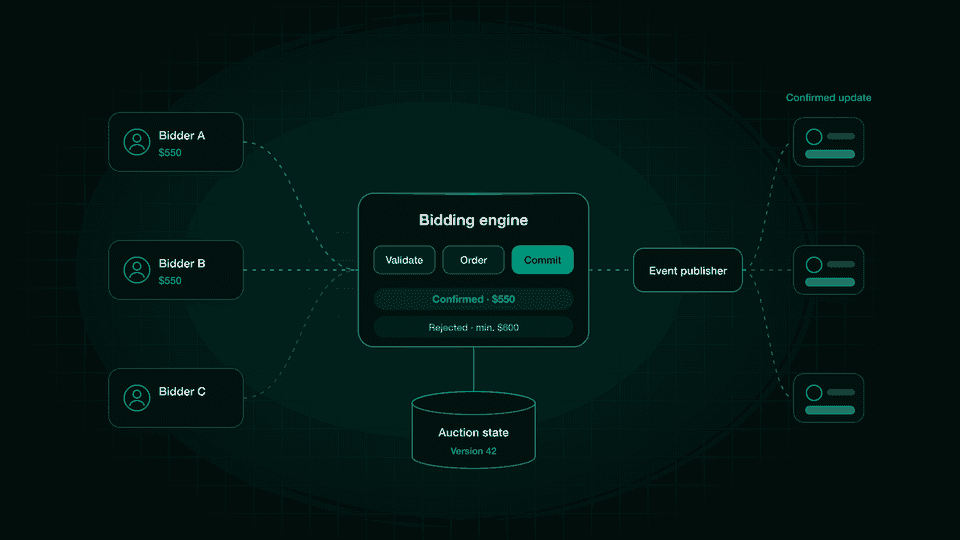
The bidding engine should produce a consistent result even when multiple participants submit bids almost simultaneously.
Transactional database
A transactional database can store auction records, accepted bids, confidential maximums, participant information and financial transaction references.
Database transactions and appropriate concurrency controls help prevent conflicting updates from producing inconsistent auction results.
PostgreSQL is one example of a relational database suitable for many transactional auction workloads. Its documentation describes the available transaction isolation levels for handling concurrent transactions.
The database and bidding engine should maintain a reliable authoritative record of each auction’s state.
Real-time communication
Technologies such as WebSockets or Server-Sent Events can distribute accepted auction updates to connected clients.
These updates may include changes to the current price, leading bidder status, remaining time and auction completion.
The real-time messaging layer should distribute confirmed results rather than independently decide which bids are valid.
Participants reconnecting after a network interruption should retrieve the latest authoritative state.
Background processing and integrations
Background jobs may handle notifications, auction scheduling, payment reminders, reporting and integrations with external systems.
Queues can help separate work that does not need to complete during the immediate bidding operation.
However, auction closure and other time-sensitive decisions must still be coordinated with the authoritative bidding state.
Handling simultaneous bids and transaction integrity
Concurrency is one of the most important engineering challenges in auction software development.
Imagine two participants submitting the same minimum bid at almost the same time.
If the platform independently validates both submissions against an outdated auction price, both could incorrectly appear to have won the same bidding position.
A reliable implementation should process competing state changes using a clearly defined concurrency strategy.
Depending on the architecture, this could involve database row-level locking, optimistic concurrency control, or serialised processing for individual auctions.
The system should also protect against duplicate submissions.
If a bidder experiences a network timeout and retries the same request, the platform should not unintentionally create multiple accepted bidding operations.
Idempotency controls help ensure repeated requests can be handled safely.
Our article on how real-time bidding works explains these mechanisms in more depth.
A well-designed auction system should additionally define how bids are ordered, how equal maximum amounts are resolved, and how bids received near the closing time are evaluated.
These rules should be consistently enforced and reflected in the published auction terms.
Auction lifecycle and closing rules
An auction should follow a clearly defined lifecycle.
For example:
-
Scheduled
-
Open
-
Closed
-
Payment Pending
-
Settled
Exceptional outcomes may include cancellation, reserve not met or payment default.
Soft-close extensions generally change the closing timestamp while the auction remains open, rather than requiring an entirely separate lifecycle state.
The transition from open to closed should be coordinated with the bidding engine.
A scheduled background job should not independently close an auction while another process is accepting a bid and extending its closing time.
Explicit lifecycle rules help ensure the platform produces reliable outcomes, even during periods of high activity.
Security, fairness and auditability
Auction platforms handle information that can have financial and commercial consequences.
Security should therefore be considered throughout development rather than added immediately before launch.
Important considerations include:
- Secure authentication and account protection.
- Role-based access controls.
- Server-side bid validation.
- Protection of confidential maximum bids.
- Rate limiting and abuse prevention.
- Secure payment integrations.
- Detection of suspicious bidding activity.
- Controlled administrative operations.
- Reliable audit records.
- Backup and disaster recovery processes.
Auction histories should record sufficient information to investigate disputes and unexpected outcomes.
Confidential bid limits should not be exposed through public APIs, frontend responses or general application logs.
Fairness is not determined by real-time interface speed alone. It depends on consistent auction rules, reliable transaction processing and transparent communication with participants.
Scalability and performance
An auction platform may experience significant differences in activity throughout an auction’s lifecycle.
Hundreds or thousands of participants may browse an item without submitting a bid, while the final minutes of a popular auction may generate concentrated bidding activity.
The architecture should distinguish between read-heavy traffic, real-time subscriptions and transactional bidding operations.
Caching, efficient database queries and horizontally scalable application infrastructure may improve capacity.
However, caching must not replace the authoritative source of truth when determining accepted bids or auction outcomes.
Businesses should test their platforms under realistic peak conditions rather than relying only on average traffic estimates.
Useful testing scenarios include:
- Many participants viewing the same auction.
- Concurrent bids on one popular item.
- Multiple auctions closing at similar times.
- Competing confidential maximum bids.
- Repeated soft-close extensions.
- Network disconnections and reconnections.
- Duplicate bidding requests.
- Payment processing failures.
The objective is not simply to serve more visitors. It is to preserve correct auction behaviour as activity increases.
Ready-made auction software or custom development?
Some businesses can launch with an existing auction software product.
Others require a platform designed specifically around their auction rules, business processes and integrations.
| Consideration | Ready-made auction software | Custom auction platform |
|---|---|---|
| Initial implementation | Often faster for standard requirements | Requires discovery and development |
| Auction rules | Limited to supported configurations | Can be designed around business requirements |
| Proxy and soft-close bidding | Depends on the product | Can be implemented with defined custom rules |
| Integrations | Depends on available APIs and connectors | Can be designed around existing systems |
| User experience | Often constrained by available templates | Tailored to participants and business operations |
| Infrastructure | Depends on the vendor and hosting model | Can be designed around expected workloads |
| Ongoing maintenance | Depends on vendor arrangements | Requires an agreed maintenance approach |
Ready-made software may be appropriate when a business follows standard auction processes and does not require significant customisation.
Custom auction platform development becomes more relevant when auction rules, settlement workflows, integrations or long-term product requirements cannot be adequately supported by an existing solution.
How to develop an online auction platform
1. Define the auction business model
Determine who sells, who participates, what assets are listed, and how the platform generates revenue.
Decide whether the platform serves one seller or supports a marketplace with multiple sellers.
2. Document the bidding rules
Define the auction types, minimum increments, reserve prices, closing conditions, bidder priority and automatic bidding behaviour.
For advanced mechanisms such as proxy bidding and popcorn bidding, document how competing instructions are resolved and how the mechanisms interact.
3. Design the participant and administration workflows
Map the complete experience from registration to bidding, winning, payment and settlement.
Include administrative tasks and exceptional scenarios.
4. Design the software architecture
Determine how auction state, accepted bids, confidential maximums, real-time communication and background processing will be managed.
Select technologies based on the actual requirements rather than architectural trends.
5. Build and test the bidding engine
Validate the auction rules against ordinary and exceptional scenarios.
Test simultaneous bids, equal maximum amounts, last-second bids, automatic bidding, extensions, retries and auction closure.
The bidding engine should be tested independently from the visual interface where practical.
6. Integrate payments and business systems
Connect the platform to appropriate payment providers and any necessary inventory management, logistics, accounting or customer relationship management systems.
7. Launch, monitor and improve
Begin with clearly defined operating requirements, monitor auction activity and investigate unexpected behaviour.
Use real operating data to guide subsequent improvements.
What determines the cost of auction platform development?
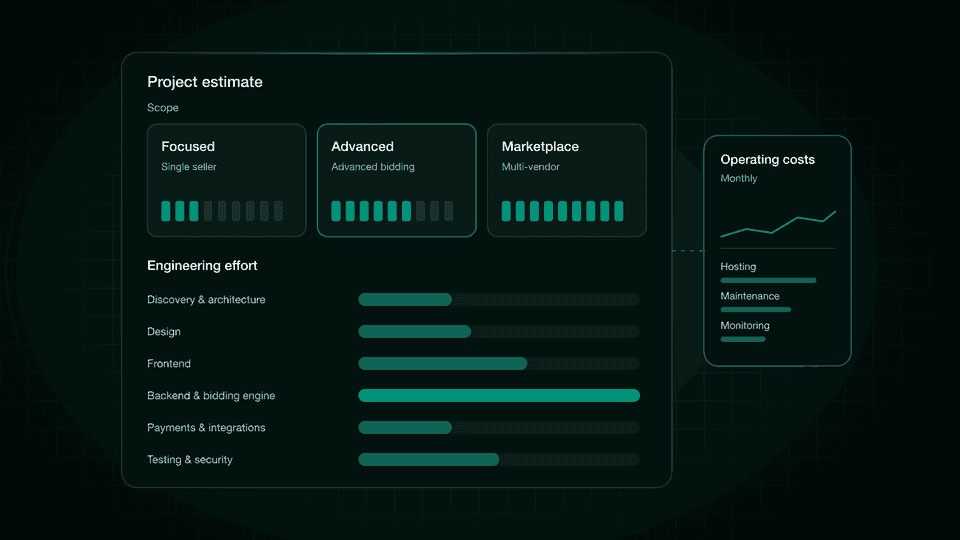
Development cost depends on more than the number of screens or website pages.
Important cost factors include:
- Supported auction types.
- Complexity of bidding rules.
- Proxy bidding and soft-close requirements.
- Participant verification.
- Marketplace and seller functionality.
- Payment and settlement workflows.
- Real-time infrastructure.
- Administrative tools.
- External system integrations.
- Security and compliance requirements.
- Expected transaction volume.
A straightforward single-seller auction website has a different scope from a multi-vendor marketplace with advanced automatic bidding, seller settlements and complex operational workflows.
A meaningful development estimate should therefore begin with a clear description of the business model and auction rules.
For example budgets and calculation methods, read our guide to auction platform development costs.
Frequently asked questions
What is online auction platform development?
Online auction platform development involves designing and building software that allows users to list assets, participate in auctions, submit competing bids and complete transactions according to predefined auction rules.
What is popcorn bidding?
Popcorn bidding is a soft-close mechanism that extends an auction when an eligible bid is accepted close to its closing time. It gives competing bidders an opportunity to respond instead of allowing the auction to end immediately after a last-second bid.
What is proxy bidding?
Proxy bidding allows a participant to define a confidential maximum amount. The bidding engine can then automatically compete on their behalf within that authorised limit and according to the auction’s rules.
Can an auction platform support both popcorn and proxy bidding?
Yes. Both mechanisms can operate within the same platform, provided their interaction is explicitly defined and consistently enforced by the bidding engine.
Can online auction platforms handle simultaneous bids?
Yes. A properly designed bidding engine can use transactional consistency and appropriate concurrency controls to process competing submissions and maintain a reliable auction state.
Can an auction platform integrate with existing business software?
Yes, provided the existing systems support suitable integration methods. Auction platforms can connect to inventory management, payment processing, accounting, CRM and logistics applications.
Do I need a custom auction platform?
Not necessarily. Ready-made software may be sufficient for standard auction requirements. Custom development becomes more relevant when the business needs specialised bidding rules, advanced integrations, tailored workflows or greater control over the platform.
Build an auction platform around your business
A reliable auction platform is more than a website with listings, prices and a countdown.
It must coordinate bidding rules, participant activity, business processes and financial transactions while maintaining consistent and fair outcomes.
Whether your business requires a single-seller auction website, a multi-vendor auction marketplace or advanced bidding functionality, the starting point is understanding how the auction should operate.
At ReemRose, we develop custom software around actual business requirements, combining software architecture, transactional systems, real-time communication and business integrations.
Explore our auction platform development solutions or contact our team to discuss the requirements of your project.
Back to Insights