An online auction website may look relatively straightforward: product listings, user accounts, a bidding interface and a countdown.
However, two auction platforms with nearly identical interfaces can have dramatically different development costs.
One may support a single business selling its own inventory through scheduled auctions. Another may need thousands of concurrent participants, automatic proxy bidding, dynamic closing times, multiple sellers, payment deposits and complex financial settlements.
The difference lies in the software behind the interface.
This guide explains how auction platform development costs are calculated, what features influence the budget and how businesses can estimate the investment required before commissioning their platform.
How much should you budget for an online auction platform?
The cost depends on the auction model, engineering requirements, integrations and expected operating conditions.
To illustrate how development budgets can be estimated, consider three project scenarios.
The following examples use an assumed blended development rate of $75 per hour. The engineering hours are hypothetical planning assumptions, not measured market averages or official ReemRose quotations.
| Platform scope | Estimated effort in this example | Illustrative budget |
|---|---|---|
| Focused single-seller auction platform | 400–700 hours | $30,000–$52,500 |
| Advanced auction platform | 800–1,400 hours | $60,000–$105,000 |
| Complex multi-vendor auction marketplace | 1,600–2,800 hours | $120,000–$210,000 |
All amounts are in US dollars and represent illustrative initial development budgets.
They exclude applicable taxes, ongoing hosting, third-party subscriptions and post-launch maintenance unless explicitly included in the project scope.
A real project may cost less or more than these examples. Existing components, team composition, geographic rates, integrations and delivery requirements can substantially change the actual budget, which can only be determined after understanding the actual requirements.
Smaller implementations or projects that reuse existing software components may require considerably lower initial investment.
What does each development scenario include?
Focused single-seller auction platform
A focused platform is designed for a business selling its own inventory through a limited number of auction formats.
A representative scope may include:
- User registration and authentication.
- Auction listings and product information.
- Scheduled timed auctions.
- Configurable bid increments.
- Server-side bid validation.
- Auction countdown and status updates.
- Basic payment integration.
- Administrative listing and auction management.
- Email notifications.
- Responsive website design.
This approach may be suitable for businesses replacing manual auction processes or launching a new digital sales channel.
Even a relatively focused auction platform requires reliable bidding and closing logic. Financial and transactional correctness should not be treated as optional features.
Advanced auction platform
An advanced platform supports more sophisticated auction rules and operational workflows.
Additional functionality may include:
- Real-time bidding updates.
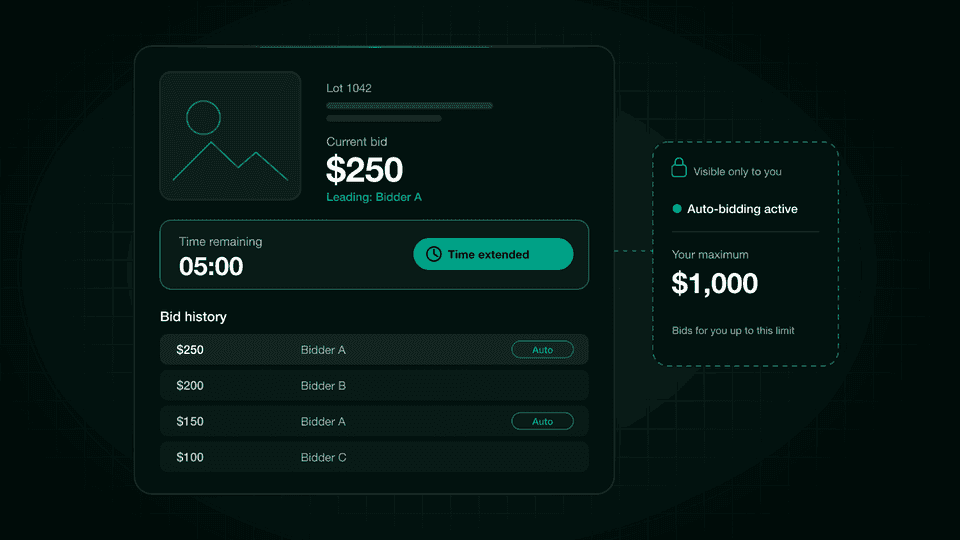
- Proxy bidding with confidential maximum amounts.
- Popcorn bidding and soft-close auction extensions.
- Advanced bidder verification.
- Bidding deposits.
- Configurable reserve prices.
- Detailed auction audit histories.
- Inventory and accounting integrations.
- Advanced administrative tools.
- More extensive performance and concurrency testing.
The additional cost comes from both implementing the functionality and testing how different mechanisms interact.
For example, a platform supporting proxy bidding and popcorn bidding must calculate the resulting public price, determine the leading bidder and update the closing time consistently.
These are not simply additional buttons in the user interface.
Complex multi-vendor auction marketplace
A multi-vendor auction marketplace introduces another layer of operational and financial complexity.
A representative scope may include:
- Seller registration and verification.
- Seller dashboards and permissions.
- Listing approval workflows.
- Multiple auction formats.
- Marketplace commissions.
- Buyer premiums.
- Deposits and payment authorisation.
- Seller settlement workflows.
- Dispute management.
- Operational analytics.
- Multi-language or multi-currency requirements.
- High-availability infrastructure.
- Advanced fraud and abuse monitoring.
The marketplace operator must manage relationships between buyers, sellers and the platform itself.
Requirements involving financial settlement, identity verification and regulatory compliance can significantly influence the engineering scope.
How are auction platform development costs calculated?
A development estimate should account for the complete software lifecycle rather than only the implementation of visible features.
The basic relationship is:
Development budget = Estimated engineering effort × Blended development rate
-
Requirements
Auction model, rules and integrations
-
Scope
Features and delivery boundaries
-
Engineering effort
Estimated hours across disciplines
-
Development estimate
Effort × blended rate
-
Operating budget
Hosting, services and maintenance
However, the engineering effort may include several disciplines:
- Requirements discovery.
- Product and user experience design.
- Software architecture.
- Frontend development.
- Backend development.
- Integration engineering.
- Quality assurance.
- Security testing.
- Infrastructure configuration.
- Project coordination.
- Release preparation.
The blended rate represents an assumed average rate across the work involved.
Different teams may estimate and price these activities differently.
A fixed-price proposal, for example, may account for delivery risk and defined acceptance criteria, while a time-and-materials arrangement may depend on actual effort throughout the project.
Why advanced bidding features affect development cost
Auction platforms require a level of transactional coordination that conventional e-commerce websites may not need.
Proxy bidding
Proxy bidding allows participants to authorise the platform to compete on their behalf up to a confidential maximum.
A reliable implementation must resolve competing maximums, minimum increments, participant priority and reserve-price interactions without exceeding authorised limits.
It must also prevent confidential maximums from being explicitly disclosed to competing participants.
The cost is influenced not only by the automatic bidding algorithm, but also by testing, auditability and interaction with other auction rules.
Popcorn bidding and anti-sniping
A five-minute soft-close auction may reset the remaining time to five minutes whenever an eligible bid is accepted during the final five minutes.
Although this appears simple in the browser, the system must update the authoritative closing timestamp while accepting the bid.
The bidding engine and auction closure process must remain synchronised even during simultaneous requests.
Concurrent bidding
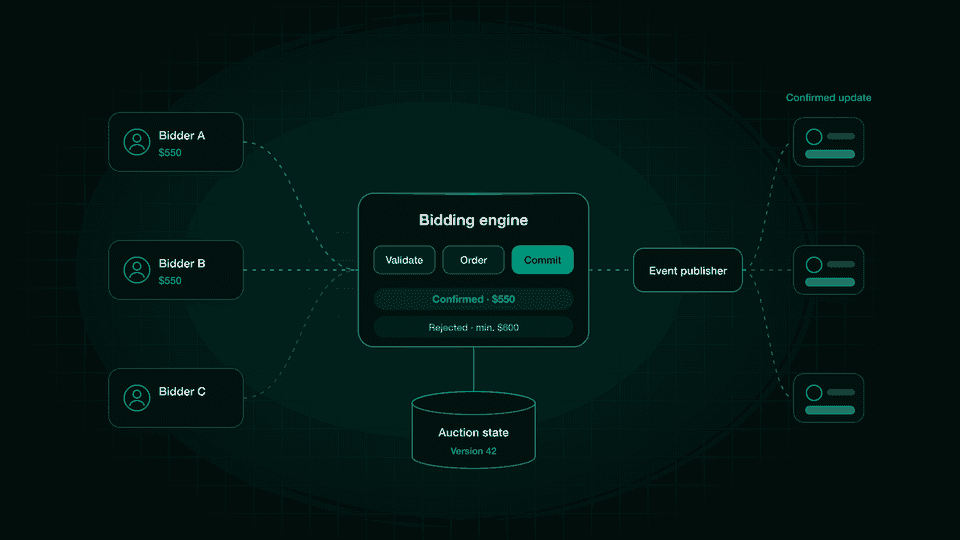
Multiple participants may submit competing bids almost simultaneously.
The system must establish a valid order, prevent conflicting state changes and ensure that every participant sees a consistent outcome.
This requires appropriate concurrency controls, duplicate-request protection and realistic load testing. Our article on how real-time bidding works explains these engineering requirements in more detail.
Businesses comparing auction development proposals should establish whether these requirements are included rather than assume they are provided by a basic bidding interface.
For a more complete overview of bidding mechanisms and platform features, read our guide to building an online auction platform.
Other factors that influence auction development costs
Mobile applications
A responsive auction website may be sufficient for the initial launch.
Dedicated mobile applications can introduce additional requirements for application development, distribution, device testing, push notifications and ongoing maintenance.
Businesses should determine whether native applications are necessary for the first release.
Payment processing and financial settlement
Payment requirements vary considerably between auction platforms.
A single-seller business may simply collect payment from the successful bidder.
A marketplace may need to manage buyer premiums, deposits, payment authorisation, refunds, seller balances and settlement workflows.
These requirements affect both integration effort and operational complexity.
The legal and regulatory implications of holding or distributing funds should also be evaluated before implementation.
External integrations
An auction platform may need to integrate with inventory management, accounting, logistics, customer relationship management or enterprise resource planning systems.
Integration costs depend on the quality of existing APIs, data formats, synchronisation requirements and error-handling workflows.
A well-documented API may be relatively straightforward to integrate. A legacy system without reliable interfaces may require substantially more engineering work.
Security and compliance
Auction platforms handle account information, confidential bidding instructions and financial transactions.
Depending on their operating model, they may require stronger authentication, identity verification, fraud controls, access restrictions and detailed audit records.
Security should be included in the development scope from the beginning.
Expected traffic and availability
The number of registered users is not sufficient to determine infrastructure requirements.
An auction may have thousands of viewers but relatively few active bidders. A popular auction may also experience intense competition during its final seconds.
The development team should understand expected concurrent viewers, bid submission rates, auction duration and availability requirements.
These conditions influence architecture, performance testing and operating costs.
Example development budget breakdown
Consider an illustrative advanced auction platform requiring 1,000 hours of work at an assumed blended rate of $75 per hour.
| Development activity | Illustrative hours | Illustrative cost |
|---|---|---|
| Discovery and architecture | 100 | $7,500 |
| User experience and interface design | 120 | $9,000 |
| Frontend implementation | 180 | $13,500 |
| Backend and bidding engine | 300 | $22,500 |
| Payments and integrations | 100 | $7,500 |
| Testing, security and infrastructure | 150 | $11,250 |
| Release preparation and coordination | 50 | $3,750 |
| Total | 1,000 | $75,000 |
This allocation is only an example of how engineering work might be distributed.
A project requiring complex seller settlement may allocate more effort to financial workflows. Another project may need extensive integrations or more demanding performance testing.
A meaningful estimate should reflect the actual distribution of work rather than apply the same percentages to every project.
Ready-made auction software versus custom development
Purchasing or subscribing to existing auction software may reduce initial development expenditure when the business has standard requirements.
Custom development becomes more relevant when existing products cannot adequately support the required bidding rules, integrations or operational processes.
| Consideration | Ready-made software | Custom development |
|---|---|---|
| Initial expenditure | Often lower for standard use cases | Depends on engineering scope |
| Implementation | Configuration and integration | Discovery, design and development |
| Bidding rules | Limited to supported functionality | Designed around defined requirements |
| Recurring fees | Vendor subscription or licensing | Hosting, maintenance and third-party services |
| Integrations | Available connectors and APIs | Custom integration options |
| Software ownership | Depends on licence terms | Depends on development agreement |
| Long-term changes | Subject to vendor capabilities | Governed by product roadmap and available resources |
The cheapest initial option is not necessarily the lowest-cost option over several years.
Businesses should compare total cost of ownership, supported features, contractual obligations and the cost of adapting the platform as their operations evolve.
What are the ongoing costs of running an auction platform?
Initial development is only one part of the investment.
Operating expenses may include:
- Application hosting.
- Database infrastructure.
- Object storage and content delivery.
- Real-time messaging infrastructure.
- Monitoring and alerting.
- Backups and disaster recovery.
- Payment processing fees.
- Identity verification services.
- Email and SMS notifications.
- Software maintenance.
- Security updates.
- Customer and operational support.
A marketplace with high transaction volumes will generally have different operating costs from a business running occasional scheduled auctions.
Cloud expenditure should be estimated using the anticipated workload rather than an arbitrary monthly hosting figure.
Maintenance requirements should also be discussed before launch, including responsibility for security updates, infrastructure monitoring, defects and future enhancements.
How to calculate the total cost of ownership
Businesses should consider the cost of developing and operating their platform over a meaningful period.
For example, an illustrative project may have:
- Initial development: $75,000.
- Assumed hosting and third-party services: $1,000 per month.
- Assumed maintenance and engineering support: $2,000 per month.
Under those assumptions, the first-year cost would be:
| Expense | First-year cost |
|---|---|
| Initial development | $75,000 |
| Hosting and third-party services | $12,000 |
| Maintenance and engineering support | $24,000 |
| Total | $111,000 |
These operating amounts are hypothetical budgeting inputs, not hosting or maintenance quotations.
The calculation excludes variable transaction fees, taxes, marketing, customer support personnel and major future feature development.
It illustrates why businesses should establish an operating budget in addition to their initial development budget.
How to reduce auction platform development costs without compromising reliability
Start with a defined auction model
Avoid implementing every possible auction format before the business has established which ones it needs.
A platform focused on ascending-price timed auctions may not initially require Dutch, reverse or sealed-bid auctions.
Prioritise essential functionality
Develop the core participant experience, bidding engine, administration workflows and payment requirements first.
Additional analytics, native mobile applications and specialised features can be introduced when justified by the business.
Reuse appropriate existing technologies
Established frameworks, databases, payment integrations and infrastructure services can reduce unnecessary engineering effort.
Custom software development does not mean rebuilding every underlying technology from scratch.
Define bidding rules before development
Changes to bid increments, closing conditions, proxy bidding or reserve-price behaviour can affect multiple parts of the platform.
Clearly documenting these rules early reduces avoidable rework.
Invest in testing from the beginning
Reducing the testing budget may appear to save money initially.
However, defects affecting accepted bids, closing times or financial transactions can create significantly more expensive problems after launch.
Testing should be considered part of the core engineering investment.
How to obtain an accurate development quotation
Before approaching an auction platform development company, prepare answers to the following questions:
- What products or assets will be auctioned?
- Who can sell and who can participate?
- Which auction formats are required?
- Will the platform support proxy or popcorn bidding?
- How will bidder eligibility be determined?
- How will payments, deposits and seller settlements work?
- Which existing business systems need to be integrated?
- How many concurrent participants are expected?
- Which countries, languages and currencies must be supported?
- Who will operate and maintain the platform after launch?
A development company should use these requirements to define the scope, identify technical risks and propose an appropriate delivery approach.
A quotation based exclusively on the number of website pages is unlikely to capture the full complexity of a sophisticated auction platform.
Frequently asked questions
How much does it cost to build an auction website?
The cost depends on the scope and delivery model. In our illustrative engineering model, a focused custom single-seller platform requiring 400–700 hours at an assumed rate of $75 per hour would represent a development budget of $30,000–$52,500. This is an example calculation, not a market average or fixed quotation.
Is an auction marketplace more expensive than a single-seller platform?
Typically, it involves a broader engineering scope because it introduces seller management, permissions, commissions, financial settlements and additional operational workflows.
Are proxy bidding and popcorn bidding expensive to implement?
Their cost depends on the auction rules and existing architecture. Correct implementation requires more than interface changes because these features interact with transaction processing, competing bids and auction closure.
Can I start with a smaller auction platform and expand later?
Yes. A carefully scoped initial release can reduce upfront expenditure. However, the core bidding engine should still be designed around reliable transaction processing and the auction rules required at launch.
How long does auction platform development take?
The timeline depends on project scope, team capacity, integrations, testing and delivery requirements. A reliable schedule should be established after discovery rather than promised without understanding the project.
Does the development budget include hosting and maintenance?
Not necessarily. These expenses should be explicitly included or excluded in the commercial proposal. Businesses should plan for ongoing operating costs separately.
Can I receive a fixed-price quotation?
A fixed-price proposal may be suitable when requirements, deliverables, assumptions and acceptance criteria are clearly defined. Projects with significant uncertainty may benefit from an initial discovery phase.
Plan your auction platform investment with ReemRose
A reliable auction platform should be designed around your business model, bidding rules and operational requirements.
Understanding these requirements before development makes it easier to establish a realistic budget, prioritise functionality and avoid unnecessary engineering expenditure.
At ReemRose, we develop custom software around actual business requirements, including advanced auction mechanisms, transactional systems and business integrations.
Explore our auction platform development solutions or contact our team to discuss your project and establish an appropriate development scope.
Back to Insights